
Article: Is 125 GSM Paper Good for Journaling? A Practical Guide to Thick Journal Paper
Is 125 GSM Paper Good for Journaling? A Practical Guide to Thick Journal Paper
Yes, 125 GSM paper is generally a strong choice for journaling. It feels more substantial than standard notebook paper, offers better opacity than lighter sheets and can create a more premium writing experience.
However, paper weight alone does not determine whether a journal will resist bleed-through, feathering or ghosting. A 125 GSM journal may perform beautifully with fountain pen ink, gel pens and fineliners—but paper finish, absorbency, sizing, surface texture and the ink itself matter too.
The difference between 120 GSM and 125 GSM is small: 125 GSM has only 5 additional grams of paper per square metre, or about 4.17% more grammage. That means the better choice is rarely about the number alone. It is about how the paper feels, behaves and supports the way you write.
Executive Summary
Yes, 125 GSM paper is generally a strong choice for journaling. It feels more substantial than standard notebook paper, offers better opacity than lighter sheets and can create a more premium writing experience.
However, paper weight alone does not determine whether a journal will resist bleed-through, feathering or ghosting. A 125 GSM journal may perform beautifully with fountain pen ink, gel pens and fineliners—but paper finish, absorbency, sizing, surface texture and the ink itself matter too.
The difference between 120 GSM and 125 GSM is small: 125 GSM has only 5 additional grams of paper per square metre, or about 4.17% more grammage. That means the better choice is rarely about the number alone. It is about how the paper feels, behaves and supports the way you write.
TL;DR
- 125 GSM paper is considered heavyweight paper for everyday journaling.
- It is only about 4.17% heavier than 120 GSM paper.
- A 125 GSM journal can feel substantial, premium and durable without becoming overly bulky.
- Higher GSM may reduce show-through, but it does not automatically guarantee no bleed-through.
- Paper texture, ink absorption, opacity and sizing matter alongside paper weight.
- Choose 125 GSM for long-form journaling, thoughtful gifting, writing rituals and premium everyday use.
- Choose 160 GSM or above when you use heavy markers, paint, wet brush pens or frequent mixed media.
What Does 125 GSM Paper Mean?
125 GSM means the paper weighs 125 grams per square metre.
GSM stands for grams per square metre, a standard measurement used to describe paper grammage. ISO 536:2019 defines the method used to determine paper grammage.
A higher GSM number usually means the paper has more mass per square metre. When the paper formulation is otherwise similar, higher grammage can create a stronger and stiffer sheet.
But GSM is not a complete measurement of paper quality.
A sheet of 125 GSM paper may feel thick and luxurious, while another 125 GSM sheet may feel softer, more textured, more absorbent or less opaque. Paper fibre blend, surface finish, sizing and manufacturing method all influence the final writing experience.
Is 125 GSM Paper Good for Journaling?
Yes. 125 GSM paper is an excellent middle ground for people who want a thick paper journal without carrying an overly bulky notebook.
It is especially suitable for:
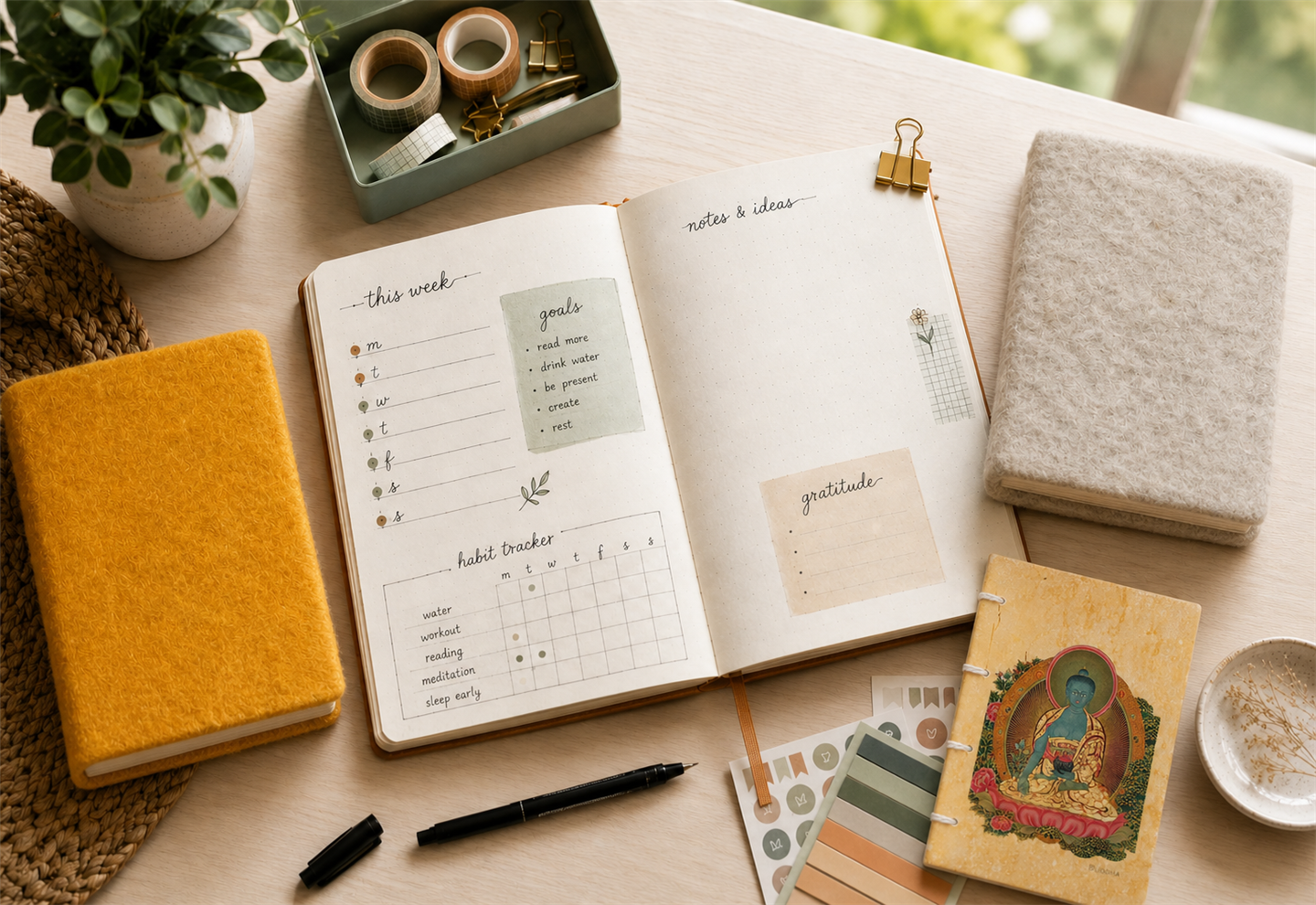
- Daily journaling
- Long-form writing
- Gratitude journaling
- Morning pages
- Personal reflections
- Travel notes
- Planning and list-making
- Gel pens and rollerball pens
- Most fineliners
- Gift journals
- Light fountain pen use, depending on the paper finish and ink
A 125 GSM journal gives writing a more intentional feel. The pages are less likely to feel flimsy, and the book often feels more like a keepsake than a disposable notebook.
120 GSM vs 125 GSM Paper: Is There a Real Difference?
| Feature | 120 GSM paper | 125 GSM paper | What it means for journaling |
|---|---|---|---|
| Grammage | 120 grams per square metre | 125 grams per square metre | 125 GSM is only 5 g/m² heavier. |
| Relative difference | — | About 4.17% more grammage | The difference may be subtle in day-to-day use. |
| Feel | Substantial and smooth, depending on finish | Slightly more substantial, depending on finish | Paper texture often matters more than the 5 GSM difference. |
| Opacity | Can have low show-through | May offer slightly better opacity | Depends heavily on fibre, fillers and paper formation. |
| Journal bulk | Usually easier to keep slim with high page counts | Can feel slightly fuller with the same page count | Binding and number of pages matter more than GSM alone. |
| Fountain pen potential | Can perform well | Can perform well | Neither GSM automatically guarantees ink resistance. |
| Best suited for | Daily notes, planning, standard journaling | Premium journaling, gifting, longer entries | Both can be excellent choices. |
A 125 GSM sheet has only 4.17% more grammage than a 120 GSM sheet. That is enough to be meaningful in paper production, but not enough to assume a dramatic difference in writing behaviour.
The more useful question is:
Does the journal paper feel right for your writing tools and the way you plan to use it?
Does 125 GSM Paper Prevent Bleed-Through?
Not automatically.
Heavier paper can help reduce bleed-through because the ink has more material to travel through. But ink performance is not determined by GSM alone.
A fountain pen with a wet broad nib may place much more ink on the page than a fine nib. A saturated ink may also behave differently from a quick-drying everyday ink. Paper that works beautifully with one pen may show bleed-through with another.
Paper standards treat grammage, thickness, opacity, smoothness and ink resistance as separate measurable properties. TAPPI, for example, lists separate standards for grammage, thickness, smoothness and ink-resistance testing.
What affects bleed-through besides GSM?
- Paper sizing
- Surface coating or finish
- Ink absorption rate
- Paper opacity
- Fibre composition
- Pen nib size
- Ink saturation
- Ink flow
- Writing pressure
- How long the ink is left pooled on the page
For this reason, a good 90 GSM fountain-pen notebook can outperform a poorly formulated 125 GSM paper.
Rhodia positions its 90 GSM paper as fountain-pen-friendly, while Goldspot sells an 80 GSM Regalia paper notebook with a zero-bleeding claim. These are brand or retailer claims rather than universal standards, but they demonstrate that paper formulation matters as much as weight.
The Difference Between Thick Paper, Heavyweight Paper and Good Paper
A thick paper journal is not automatically a better journal.
The best journal paper balances:
- Writing comfort
- Opacity
- Ink control
- Dry time
- Page durability
- Smoothness or texture
- Page count
- Portability
- The intended writing tool
Thick paper is useful when you want:
- A premium tactile experience
- Less show-through
- More confidence writing on both sides
- Better support for heavier everyday pens
- A keepsake-style journal
- A stronger page that feels substantial in hand
Lighter paper is useful when you want:
- More pages in a compact format
- A slim travel journal
- Faster page turning
- Better portability
- Less overall weight in a daily bag
- A notebook designed specifically for a particular ink-friendly paper formulation
Case Study: Why GSM Alone Does Not Decide Paper Quality
The stationery market itself proves that different paper weights can serve different needs.
| Example | Paper weight | Product positioning | What it shows |
|---|---|---|---|
| Leuchtturm1917 120G notebook | 120 GSM | Extra smooth, low show-through, designed for fountain pens and markers | 120 GSM can be premium writing paper. |
| Rhodia Webnotebook | 90 GSM | Fountain-pen-friendly, smooth, acid-free paper | Lower GSM can still suit ink users. |
| Endless Regalia notebook | 80 GSM | Acid-free paper with an ink-friendly, zero-bleeding claim | Paper formulation may matter more than thickness. |
| Archer & Olive journal | 160 GSM | No ghosting or bleeding, suitable for heavy journaling and illustration | Higher GSM can better support marker-heavy layouts. |
Leuchtturm1917 positions its 120 GSM notebook around smoothness and low show-through, while Archer & Olive uses 160 GSM paper for highly layered creative use. Rhodia and Endless demonstrate that lighter paper can also be suitable for fountain pen users when it is made for ink performance.
The lesson is simple:
Choose paper by intended use, not by GSM alone.
Is 125 GSM Paper Good for Fountain Pens?
It can be, but it should be tested rather than assumed.
Many fountain pen users prefer paper that limits feathering, reduces bleed-through and still allows ink colour, shading and writing character to show clearly. The Gentleman Stationer, a long-running fountain-pen reviewer, notes that its own paper rankings depend on the kind of writing being done, including drafting, note-taking, wet ink samples and flex-nib calligraphy.
That is an important point for journal buyers.
A journal that performs well for everyday writing may not perform the same way with:
- Broad nibs
- Stub nibs
- Flex nibs
- Shimmer inks
- Highly saturated inks
- Wet calligraphy-style writing
- Heavy ink swatches
Use this fountain pen checklist
Before choosing a journal, look for:
- A clear paper GSM specification
- Information about paper finish
- Product photos showing both sides of a written page
- Test results with fountain pens, where available
- Reviews from users with similar pen habits
- A lay-flat or open-flat binding for comfortable writing
- Product claims that specify what was actually tested
Avoid absolute promises such as “bleed-proof” unless the brand explains the testing conditions.
Is 125 GSM Paper Better Than 120 GSM Paper?
Not necessarily.
Choose 125 GSM over 120 GSM when you value a slightly more substantial page, a premium tactile feel or a journal designed to become a keepsake.
Choose 120 GSM when you prefer a notebook that may remain marginally slimmer while still offering a premium writing surface.
For most journalers, the difference will be less noticeable than:
- The paper texture
- The colour of the paper
- The quality of the binding
- The journal’s page count
- Whether it lies flat
- Whether it suits their preferred pen
- Whether the journal feels meaningful enough to use consistently
A Simple Decision Framework
| Your journaling style | Best paper direction | Why |
|---|---|---|
| Everyday written reflections | 120–125 GSM | Substantial enough for daily writing without excessive bulk. |
| Long-form journaling | 125 GSM | A premium, durable feel for pages you may revisit. |
| Fountain pen writing | Test paper first | Ink flow, paper sizing and surface matter as much as GSM. |
| Bullet journaling with mildliners | 120–125 GSM | Often suitable for standard layouts and light highlighting. |
| Heavy markers and brush pens | 160 GSM or tested specialty paper | More protection against show-through and bleed-through. |
| Watercolour or wet mixed media | 160 GSM or dedicated watercolour paper | Better suited to high water and pigment load. |
| Travel journaling | 90–120 GSM | A slimmer notebook can be easier to carry. |
| Gift journal | 125 GSM | Creates a more premium, substantial unboxing and writing experience. |
Why 125 GSM Feels Premium in a Journal
A premium journal is not only about the cover.
Paper affects the emotional experience of writing. When pages feel substantial, the act of journaling can feel slower, more deliberate and more personal.
A 125 GSM journal can support that feeling because it often offers:
- A more luxurious page turn
- Greater confidence when writing on both sides
- Better resistance to crumpling during everyday use
- A more substantial book feel
- A stronger foundation for personal writing rituals
- A more gift-worthy impression
This is particularly relevant for journals meant for reflection, memory keeping, travel, gratitude, writing practice or thoughtful gifting.
Is 125 GSM Paper Acid-Free?
Not always.
Paper weight and acid-free status are separate attributes.
A journal can be 125 GSM and not acid-free. Another journal can be 90 GSM and acid-free. Permanent paper standards focus on long-term durability, not paper weight alone. ISO 9706:2025 specifies requirements for permanent paper intended for documents.
For journaling, acid-free paper can be especially useful when you want writing, memories, sketches or personal records to remain stable over time.
Choosing a NOTERA Journal With 125 GSM Paper
NOTERA’s 125 GSM handmade acid-free paper journals and notebooks are best positioned for people who want more than a place to take notes.
They are suited to:
- Personal reflection
- Daily journaling
- Writing rituals
- Meaningful gifting
- Travel memories
- Creative planning
- Long-form handwritten notes
- Keepsake-style writing
For a compact, carry-everywhere option, direct readers to NOTERA pocket diaries. For everyday writing and work notes, direct them to NOTERA notebooks. For reflective writing, gifting and deeper personal use, direct them to NOTERA journals.
The right choice is not simply the largest or heaviest book. It is the format that makes the reader want to return to the page.
Checklist: What to Look for in a Thick Paper Journal
Before purchasing a heavyweight journal, ask:
- Is the paper weight clearly listed?
- Is the paper acid-free?
- Is the paper handmade, machine-made or specialty writing paper?
- Does the journal lie flat when open?
- Is the paper blank, ruled, dotted or structured?
- Will I use fountain pens, markers, gel pens or brush pens?
- Do I want a compact notebook or a substantial keepsake?
- Do I care more about page count or paper thickness?
- Does the paper feel smooth, textured, soft or rigid?
- Is the journal designed for writing, planning, sketching or mixed media?