

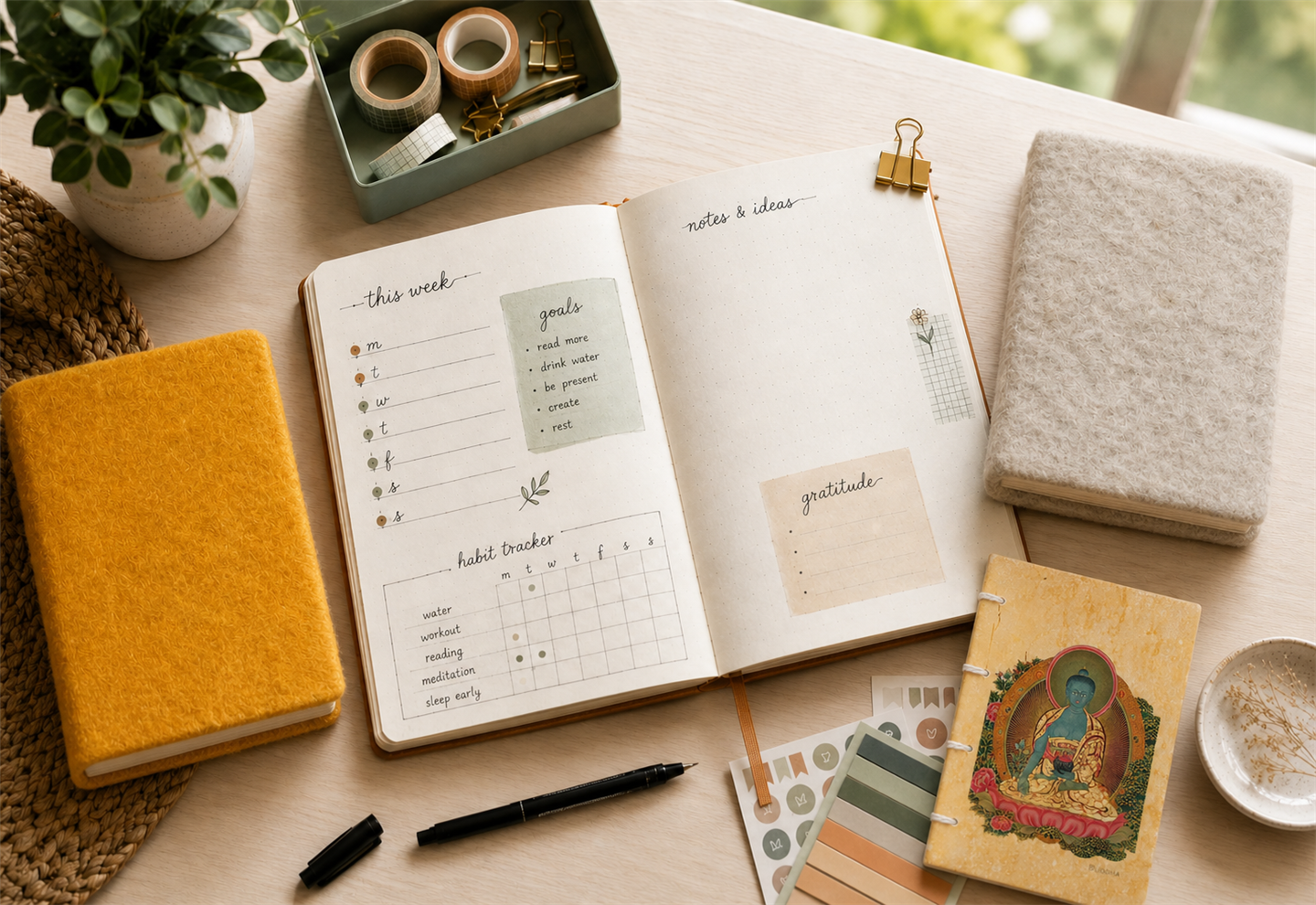
Bullet Journaling: What It Is, How to Start and Simple BuJo Planning Ideas
Bullet journaling is a flexible notebook method for organising tasks, events, notes and personal projects in one place. It is not a requirement to draw elaborate monthly covers, create complicated habit trackers or make every page beautiful.
At its core, the method is simple: record what matters, keep entries short, group related notes together, review unfinished tasks, and carry forward only what still deserves your attention.
The system can become a planner, notebook, journal, project tracker, study log, reading record or creative idea space. The best Bullet Journal is not the most aesthetic one. It is the one you keep using.
TL;DR
- A Bullet Journal is a flexible paper system for tasks, events, notes and projects.
- The core method includes an index, future log, monthly log, daily log, collections and migration.
- Rapid Logging means recording short task, event and note entries rather than long paragraphs.
- You do not need dot-grid paper, calligraphy, stickers or expensive pens.
- Dotted pages are popular because they guide layouts lightly, but lined, blank and grid notebooks can also work.
- Start with a simple monthly log, daily log and one collection.
- Use migration to decide whether unfinished tasks still matter.
- Keep only trackers and spreads that change what you do.
- A Bullet Journal should reduce friction, not become another task to maintain.
What Is a Bullet Journal?
A Bullet Journal is a notebook-based method for recording and reviewing tasks, events, notes and projects through short entries, collections and regular reflection.
The official method uses Rapid Logging: concise entries marked as tasks, events or notes. It then organises information through an index, future log, monthly log, daily log and themed collections.
A Bullet Journal is not a type of notebook. It is a flexible method for organising life on paper. A dotted notebook is common because dots help create simple calendars, trackers and tables without dominating the page. But the method can work in lined, blank or grid notebooks too.
How Bullet Journaling Works
Rapid Logging
Rapid Logging means writing short entries rather than full sentences whenever possible.
| Entry type | Simple symbol | Example |
|---|---|---|
| Task | • | • Send project outline |
| Event | ○ | ○ Parent-teacher meeting, 4 p.m. |
| Note | – | – Priya prefers the second cover option |
| Completed task | X | X Send project outline |
| Migrated task | > | > Book dentist appointment |
| Scheduled task | < | < Renew passport in September |
Core Pages
| Page | Purpose |
|---|---|
| Index | Helps you find important pages later |
| Future Log | Holds dates and tasks beyond the current month |
| Monthly Log | Gives a month-level overview of dates and tasks |
| Daily Log | Captures everyday tasks, events and notes |
| Collections | Holds related projects, lists, research or ideas |
| Migration review | Helps decide what still deserves time and energy |
The NOTERA Bullet Journal Method
Capture → Clarify → Choose → Continue
1. Capture
Write things down when they arrive. Capture:
- Tasks
- Appointments
- Questions
- Ideas
- Notes from meetings
- Grocery reminders
- Reading suggestions
- Project thoughts
- Travel plans
- Personal reflections
Do not worry about where every item belongs at first. The first job of a Bullet Journal is to give information a reliable place to land.
2. Clarify
At the end of a day or week, sort important material into a useful place. Examples of collections:
- Reading list
- Travel planning
- Work project
- Study revision
- Gift ideas
- Home repairs
- Recipes to try
- Therapy questions
- Business ideas
- Creative writing fragments
The official method describes collections as grouped information around a shared theme or purpose, and recommends adding the topic and page number to the index so it can be found later.
3. Choose
At the end of the month, review unfinished tasks. Ask:
- Does this still matter?
- Is this a task, project or someday idea?
- Can I do it now?
- Should I schedule it later?
- Should I remove it?
Migration is designed to turn task copying into a decision process. The official method frames it as a way to separate what is worth carrying forward from what is no longer relevant.
4. Continue
A Bullet Journal becomes useful through repetition, not through the first setup. Keep the system easy enough to return to:
- Add one daily log.
- Review once a week.
- Start a new monthly page.
- Update your index when you add a collection.
- Use only the layouts that help you make decisions.
How to Start a Bullet Journal for Beginners
You need:
- One notebook
- One pen
- Ten to twenty minutes
- A reason you want to use the system
You do not need:
- Perfect handwriting
- Dot-grid paper
- Stickers
- Highlighters
- Complicated trackers
- A completed annual setup
- A social-media-ready cover page
Step 1: Set an Intention
Write one sentence inside the cover: "I am using this journal to keep my tasks, notes and priorities in one place."
Other useful intentions:
- To remember less in my head
- To manage study and work together
- To plan more calmly
- To track projects without digital clutter
- To make more room for creative ideas
- To review what matters each month
Step 2: Create an Index
Reserve the first two pages.
| Topic | Pages |
|---|---|
| August monthly log | 3–4 |
| Reading list | 5 |
| Project notes | 6–9 |
| Travel planning | 10–12 |
Step 3: Create a Future Log
Use a page or spread for upcoming months.
| Month | Future dates and reminders |
|---|---|
| July | Dentist appointment, friend's birthday |
| August | Course registration |
| September | Travel booking deadline |
Step 4: Create a Monthly Log
Use one page for dates and one page for tasks.
Left page:
- August 1 — Friday
- August 2 — Saturday
- August 3 — Sunday
Right page:
- Submit assignment
- Buy birthday card
- Review project budget
The official beginner setup uses a calendar page and a monthly task page.
Step 5: Start a Daily Log
Write today's date at the top of the next page. Then capture:
- Tasks
- Events
- Notes
- Thoughts
- Quick ideas
Keep entries short.
Step 6: Add One Collection
Choose something you already need. Examples:
- Books to read
- Dinner ideas
- Project notes
- Study topics
- Travel planning
- Content ideas
- Gifts to buy
- Questions to ask
Do not add ten collections on day one.
What Is Bullet Journal Migration?
Migration is the practice of reviewing unfinished tasks and deciding whether to move them forward, schedule them later, add them to a collection or remove them. This is one of the most useful parts of the method because it stops a to-do list from becoming an archive of obligations.
Migration is not rewriting every unfinished task. It is deciding whether that task is still worth your attention.
The official method recommends reviewing open tasks at the end of a month, marking completed items, crossing out irrelevant ones and moving only still-relevant tasks into the next monthly log, future log or relevant collection.
Monthly Migration Questions
- Did I complete this?
- Does this still matter?
- Is this really a task or a larger project?
- Can I schedule it?
- Should I delegate it?
- Is this a someday idea instead?
- Am I carrying this forward only because I wrote it down?
Bullet Journal Ideas That Are Actually Useful
A collection should earn its space.
Practical Collections
| Collection | Best for |
|---|---|
| Reading list | Books, articles and recommendations |
| Project dashboard | Next actions, decisions and deadlines |
| Gift ideas | Birthdays, occasions and small notes |
| Meal list | Go-to dinners and recipes to try |
| Travel plan | Routes, bookings, packing and places |
| Home list | Repairs, purchases and future projects |
| Learning log | Courses, concepts and questions |
| Meeting notes | Decisions and follow-ups |
| Content ideas | Blog topics, captions and campaign notes |
| Personal admin | Documents, renewals and reminders |
Reflective Collections
| Collection | Best for |
|---|---|
| Gratitude log | One small thing worth noticing |
| Monthly reflection | What worked, what did not, what changed |
| Wins list | Progress that might otherwise be forgotten |
| Energy notes | What gave or drained energy |
| Memory page | A moment, ticket, sketch or quote |
| Letter to future self | Seasonal reflection |
| Morning pages | Unfiltered writing |
| Dream fragments | Images and ideas after waking |
Creative Collections
| Collection | Best for |
|---|---|
| Sketchbook prompts | Drawing practice |
| Story ideas | Scenes, characters and dialogue |
| Colour palettes | Visual inspiration |
| Travel observations | Places, sounds and details |
| Quotes and phrases | Writing inspiration |
| Design references | Materials, forms and moods |
| Personal symbols | Visual language for journaling |
Bullet Journal Layout Ideas
1. Minimal Daily Log
Best for: busy professionals, students and beginners.
Layout: date, three priorities, rapid log, one note to future self.
Example — Tuesday, August 12: 1. Finish proposal, 2. Call mother, 3. Read chapter 4. Then: • Finish proposal outline, ○ Team call, 2 p.m., – Need a clearer opening paragraph.
2. Weekly Priorities Page
Best for: people who need a simple weekly overview.
| Section | Include |
|---|---|
| Top three priorities | The work that matters most |
| Fixed dates | Appointments and deadlines |
| Task list | Flexible actions |
| Notes | Ideas and reminders |
| Review | One win and one adjustment |
3. Project Dashboard
Best for: work projects, school assignments and creative launches.
| Section | Include |
|---|---|
| Goal | What success looks like |
| Next actions | Concrete tasks |
| Waiting on | People or information needed |
| Notes | Ideas, decisions and references |
| Deadline | Important timing |
| Review date | When to revisit the page |
4. Simple Habit Tracker
Best for: one or two habits, not a complete self-surveillance system.
| Habit | Mon | Tue | Wed | Thu | Fri | Sat | Sun |
|---|---|---|---|---|---|---|---|
| Morning walk | ✓ | ✓ | ✓ | ✓ | |||
| Read 10 pages | ✓ | ✓ | ✓ | ✓ | ✓ |
5. Monthly Reflection
Best for: making the journal more than a task list. Prompts:
- What worked this month?
- What created unnecessary pressure?
- What did I finish?
- What should I stop carrying forward?
- What needs more attention next month?
- What surprised me?
- What do I want to remember?
Bullet Journal vs Planner vs Notebook
| Tool | Best for | Main strength | Main limitation |
|---|---|---|---|
| Bullet Journal | Flexible tasks, notes, collections and review | Adapts to changing needs | Requires some setup and regular review |
| Planner | Dates, deadlines, routines and weekly visibility | Quick, structured planning | Less flexible if layouts do not suit you |
| Notebook | Notes, ideas, meetings and writing | Fast and simple | Can become hard to search without an index |
| Journal | Reflection, memory keeping and long-form writing | Personal and expressive | May not support scheduling clearly |
| Pocket diary | Quick capture and portability | Easy to carry | Limited space |
| Sketchbook | Visual thinking and drawing | Open creative space | Less suited to dense planning |
Do You Need a Dotted Notebook for Bullet Journaling?
No. A dotted notebook is popular because it gives light guidance for straight lines, calendars, tables and trackers. But Bullet Journaling can work in ruled, blank or grid notebooks.
Moleskine currently offers ruled, plain, squared and dotted notebook formats, while Bullet Journal guidance treats page structure as adaptable to the user rather than fixed to one format.
Choose a Dotted Notebook If You Want:
- Flexible weekly layouts
- Habit trackers
- Custom calendars
- Tables
- Project maps
- A mix of writing and diagrams
- Gentle visual guidance
Choose a Lined Notebook If You Want:
- Simple daily logs
- Long writing
- Meeting notes
- Study notes
- Lists
- A fast start with no layout drawing
Choose a Blank Notebook If You Want:
- Visual journaling
- Sketches
- Collage
- Mind maps
- Freeform writing
- Travel pages
Choose a Grid Notebook If You Want:
- Charts
- Tables
- Maths
- Data tracking
- Diagrams
- Technical notes
Bullet Journaling Without Perfection Pressure
The biggest beginner mistake is assuming a Bullet Journal must look impressive. It does not.
The official beginner guidance explicitly says that a monthly cover page is optional, and a simple month title across two pages is enough.
The Golden Rule
A layout is useful only when it helps you notice, decide, remember or act. Avoid creating pages that:
- Take longer to decorate than to use
- Track habits you never review
- Make you feel guilty for missing a day
- Copy a social-media layout that does not fit your life
- Turn the journal into a performance
- Require a large supply collection to maintain
A plain page with three priorities can be a complete Bullet Journal page.
Bullet Journal Ideas for Different Needs
For Students
- Assignment tracker
- Exam countdown
- Reading log
- Lecture-note index
- Study session review
- Question bank
- Vocabulary list
- Project dashboard
For Professionals
- Meeting notes
- Project next actions
- Weekly priorities
- Follow-up list
- Decision log
- Content ideas
- Travel planning
- Professional learning notes
For Writers
- Story fragments
- Character notes
- Book-reading log
- Submission tracker
- Writing schedule
- Quote collection
- Research pages
- Creative prompts
For Parents
- Family calendar
- School reminders
- Meal plan
- Packing list
- Gift ideas
- Household projects
- Child memory notes
- Shared to-do list
For Travellers
- Packing list
- Reservation details
- Route plan
- Expense notes
- Food memories
- Sketches
- Place recommendations
- Travel reflection page
For Creatives
- Sketch prompts
- Mood board notes
- Colour palettes
- Material research
- Project timeline
- Client notes
- Concept maps
- Portfolio ideas
A Minimalist Bullet Journal Setup
Use only six pages to begin.
| Page | What to add |
|---|---|
| 1–2 | Index |
| 3–4 | Future Log |
| 5–6 | Current Monthly Log |
| Next page | Daily Log |
| Next page | One Collection |
| Final page | Monthly reflection |
Bullet Journal for Work and Personal Life
A Bullet Journal can hold work and personal life together, but only if the system stays clear.
Option 1: One Journal, Shared System
Use signifiers: W = work, P = personal, H = home, S = study.
Example: W • Send proposal — P ○ Dentist, 5 p.m. — H • Order light bulbs — S – Review chapter notes.
Option 2: One Journal, Separate Collections
Keep one daily log, but use separate collections:
- Work projects
- Personal goals
- Household planning
- Learning notes
- Creative ideas
Option 3: Two Journals
Use separate books when:
- Work notes are confidential
- You need a clean professional notebook
- Personal reflection needs privacy
- You manage a large volume of work information
- One notebook becomes too difficult to scan
Expert Insight: The Index Is More Valuable Than a Perfect Spread
The official Bullet Journal index exists to help users locate important pages later. It can list monthly logs and collections, and it works best when updated as topics appear.
A useful index beats an aesthetic page you cannot find again. For most users, index: monthly logs, major projects, reading lists, travel plans, study collections and important personal reference pages. Do not worry about indexing every daily page.
Case Snapshots
Official Bullet Journal Method: Rapid Logging and Migration
The official method uses concise task, event and note entries, then asks users to review unfinished tasks through migration. The core value is not page decoration. It is a repeated practice of capture and prioritisation.
Moleskine: Dots as a Flexible Planning Surface
Moleskine positions dotted pages as an open format for mapping, tracking, planning and long- or short-term goals. Dotted pages can be useful, but the real buying decision should be based on the user's writing and planning habit.
Papier: Dotted Pages for Custom Calendars and Lists
Papier presents dotted notebooks as suitable for custom calendars, planning layouts, to-do lists and expense tracking. Explain page use first, then recommend a product format.
Choosing a NOTERA Product for Bullet Journaling
The best NOTERA choice depends on the page layout and product details confirmed on the live product page.
| NOTERA collection | Best role in a BuJo-style system |
|---|---|
| Artwork Notebooks | Daily logs, work notes, collections and project pages |
| Felt Notebooks | Premium desk planning and personal project journals |
| Artwork Planners | Structured scheduling, routines and date-led planning |
| Artwork Pocket Diary Sets | Quick capture, portable task lists and travel planning |
| Felt Pocket Diaries | Compact everyday planning and reflective capture |
| Artwork Journals | Long-form reflection, monthly review and memory keeping |
| Felt Journals | Tactile reflection and meaningful personal planning |
| Artwork Sketchbooks | Visual collections, mind maps, diagrams and creative layouts |
| Felt Sketchbooks | Creative planning, drawing and expressive visual records |
Where a specific NOTERA product confirms blank pages, lined pages, handmade paper, acid-free paper, deckle edges, 125 GSM paper, Swiss binding or stitched construction, use those exact attributes. Do not call an item a Bullet Journal, dot-grid notebook or planner system unless that specific format is confirmed.
Bullet Journal Starter Checklist
Before starting, ask:
- What do I need one notebook to help me manage?
- Do I need planning, notes, reflection or project tracking?
- Do I want a lined, dotted, blank or grid page?
- Will I use one notebook for everything or separate work and personal books?
- What is my minimum daily entry?
- Which future dates do I need to track?
- Which one collection would be useful immediately?
- How often will I review unfinished tasks?
- Which trackers genuinely affect my decisions?
- What can I remove from the setup?